
Teaching Cub Scouts How to Build a Fire

My Bear and I have been reading The Genius Files: Mission Unstoppable, and one of the main characters talks about the science behind fire. We learned that you have to have three things to have a fire: heat, oxygen and fuel. What a coincidence that I’m writing about fire today!
In the new Cub Scout program, Webelos are required to build a fire in one of their Adventures.
Webelos Elective Adventure Let’s Camp 7: Using tinder, kindling, and fuel wood, properly build a teepee fire lay. If circumstances permit and there is no local restriction on fires, show how to safely light the fire while under adult supervision. After allowing the fire to burn safely, extinguish the flames with minimal impact to the fire site.
The first step in building a campfire is to find out if you can build the campfire. Ask your campground manager if campfires are allowed. You may need a permit, so ask about that as well. Check the weather too. If your area has been hot and dry, there may be a weather restriction on fires.
Next, choose your campfire location. If the campground already has a fire pit or fire ring, use that. Otherwise, find an area that is at least fifteen feet away from tent walls, shrubs, trees or anything else that might catch on fire. Look up too. There may be low-hanging tree branches overhead.
I’ve read conflicting information about building fire rings out of rocks. Many people say it is important to use a fire ring to contain the fire. Others say that it’s possible the rocks may split or even explode depending on the type of rock and whether or not it is holding moisture. It’s also been argued that by moving the rocks, you are not “leaving no trace.” So use your best judgement about rock fire rings.
NPR’s Summer Science program has an excellent infographic on the steps to take to build a fire. They showed the steps much better than I could write them! 🙂
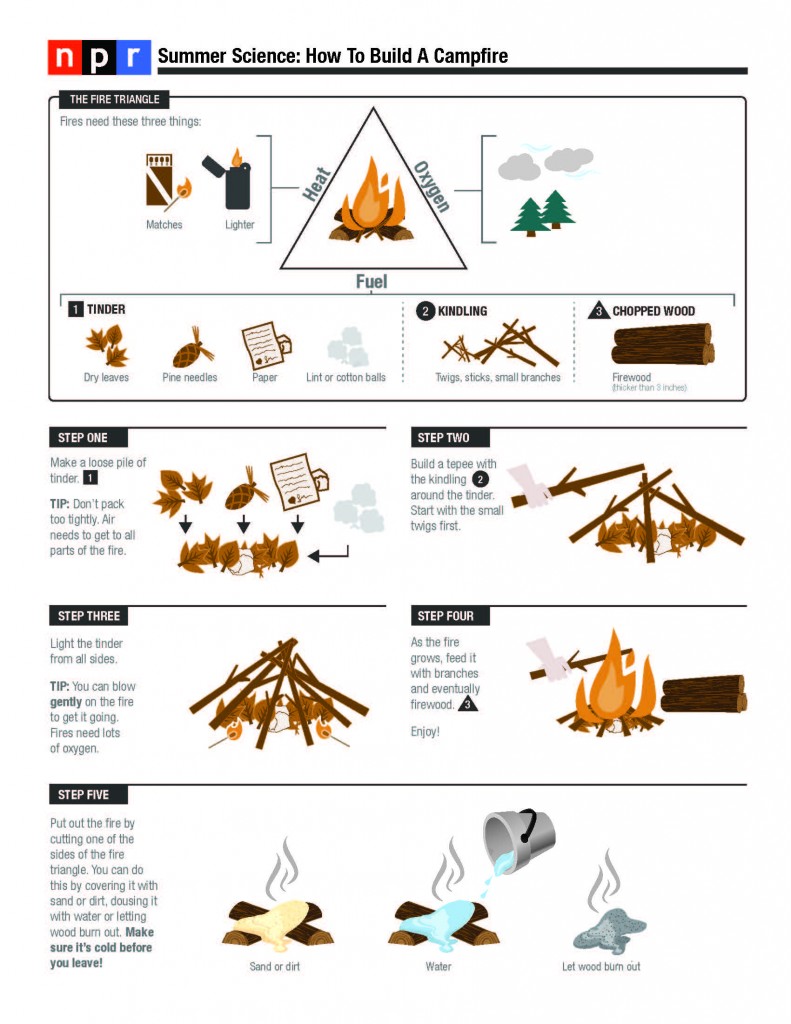
If your Webelos follow these steps, they’ll learn how to safely build a fire and complete the Cast Iron Chef requirement.
Do you have other ways of building fires?
Yours in Scouting,
Sherry
7 responses
-
Very helpful. Thank you
-
[…] Start by building your fire safely. The Webelos handbook has great instructions for this in the Cast Iron Chef adventure. You can also learn how to build a fire with this post. […]
-
[…] is struck by steel, it creates a spark to light a fire. This is kind of like when Boy Scouts learn to start a fire out of sticks and stones, but it’s much more […]
-
Thank you for that great infographic. Once again, your website has helped me with my den meeting planning!
-
Thanks for the kind words! I appreciate you reading the blog!
-
-
In California it has almost become normal to not light a fire. But when we do it’s either above ground or in an existing fire ring.
As i understand it, lighting a fire on the ground sterilizes the ground underneath killing the microorganisms that promote a healthy ecosystem and permanently scars the landscape. Certainly leave no trace rules apply even if you can’t directly see the harm being done.
It used to be that you could remove the sod and dig a hole for your fire. I’m not certain that’s even a good idea any longer.
Fires are nice but should be saved for existing sites in developed areas with permission of the land manager.
-
@Stephen Cerruti, that’s honestly the dumbest thing I’ve ever heard. You should actually do research on this topic before you post incorrect information on a scout website. It’s HEALTHY to have controlled burns for a variety of reasons. Here’s a few:
Reduce the risk of wildfires
Controlled burns reduce the amount of fuel available for intense wildfires by removing dead trees, shrubs, and other vegetation.
Improve wildlife habitat. Something you should have figured out by now in CA. When Californian’s insisted on not burning, is when you had out of control wildfires. You MUST kill the underbrush to promote healthy environment.Controlled burns create a variety of habitats for different plants and animals. They can also stimulate seed germination and provide open spaces for wildlife to travel, feed, and rest.
Increase biodiversity
Controlled burns increase the diversity of plant species and attract more birds and animals.Improve water quality
Controlled burns remove thick shrubs and overgrown vegetation, which can increase water quantity and quality.Recycle nutrients
Controlled burns recycle nutrients back into the soil.Reduce the spread of pests
Controlled burns can help reduce the spread of invasive and pest species.Reduce greenhouse gas emissions
Controlled burns keep carbon stored in trees, which can reduce greenhouse gas emissions.Promote the growth of native plants
Controlled burns promote the growth of native warm-season prairie grasses and other plants.Controlled burns are a forest management tool that mimics the low-intensity fires that naturally occur in many ecosystems.
-
Leave a Reply