
- Cub Scout Activities
- |
- Cub Scout Bears Adventures & Requirements
- |
- Cub Scout Webelos Adventures & Requirements
How to Easily Make a DIY Hiking Stick
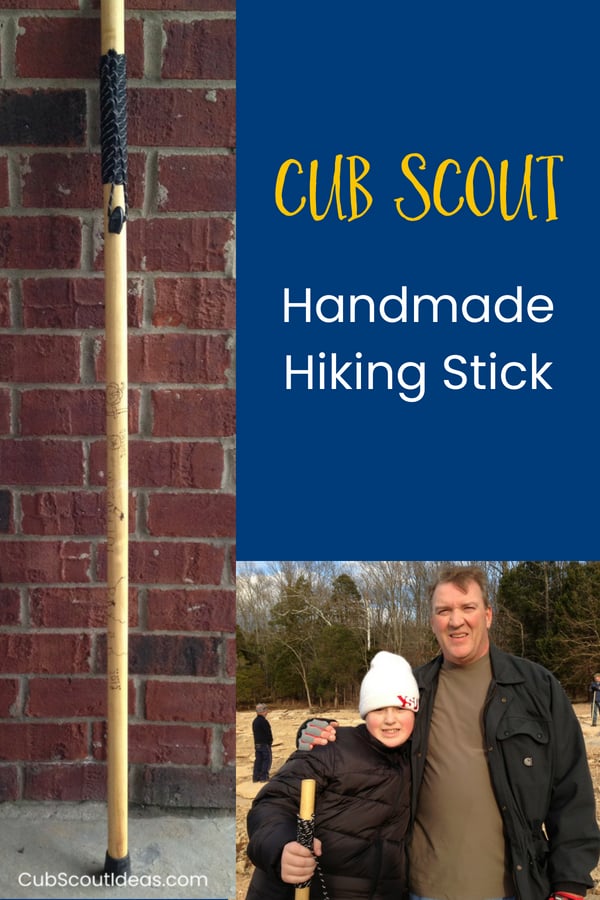
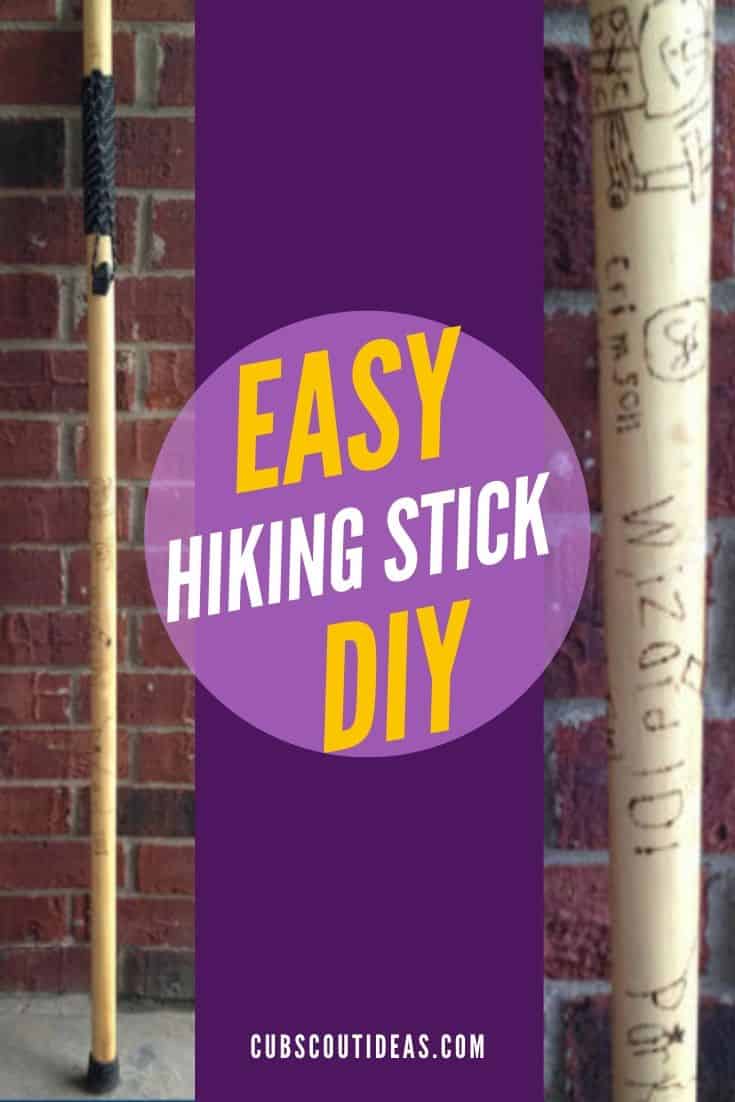
Your Cub Scout can make a handmade hiking stick. This fun craft project is useful and can bring back fond memories when they hike with it for years to come.
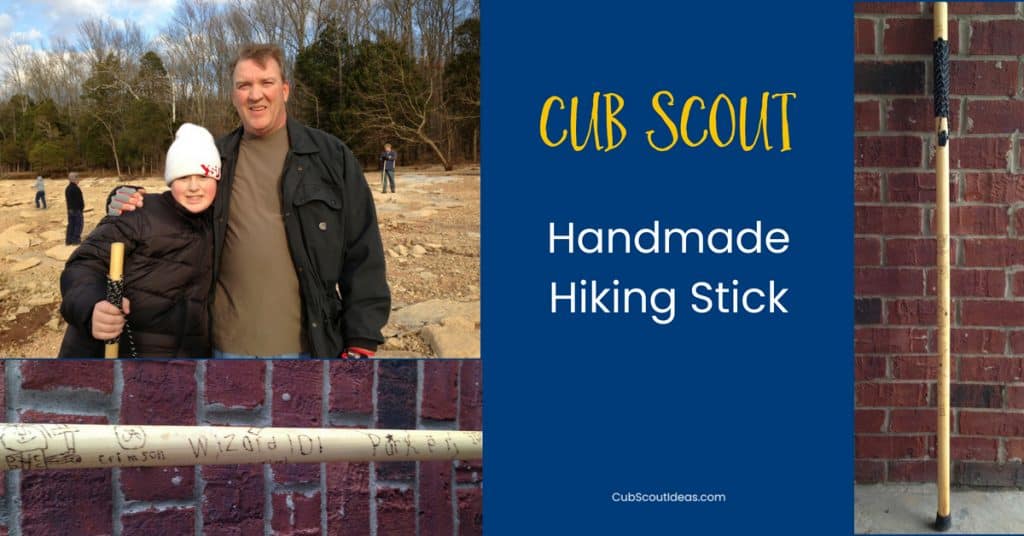
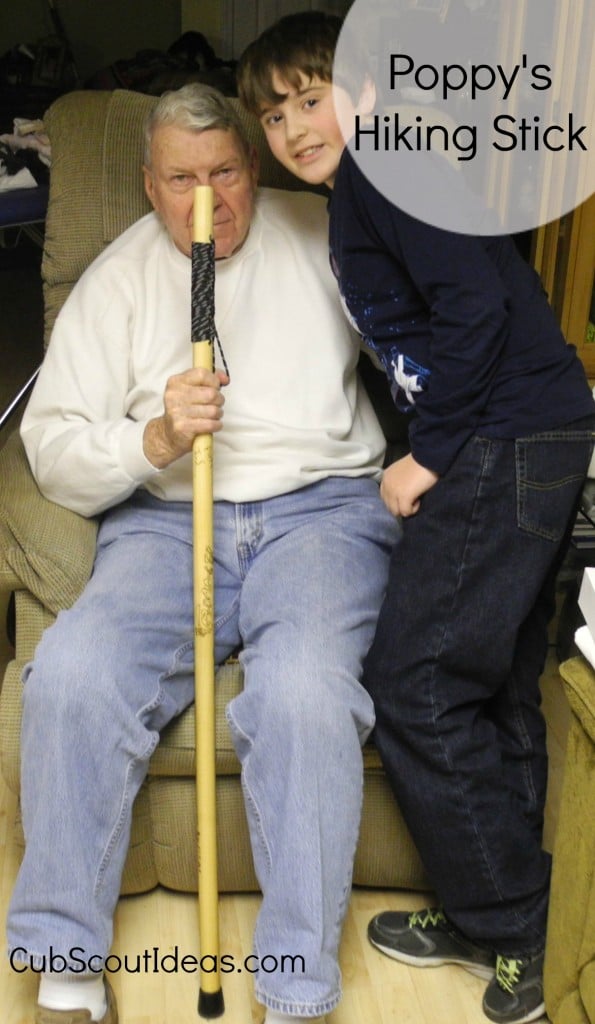
A couple of years ago, one of the dads who was attending Cub Scout Day Camp with us shared his plans for making hiking sticks. They are awesome!
It will take the Scouts a few weeks to finish them if they only work on them during den meetings. The nice thing about this project is that the steps can be done during a den meeting or at home.
My Webelos den made these handmade hiking sticks, and they turned out great! Parker used his on a cold January hike. This is a good project for your Bears or Webelos. In fact, it’s a perfect Baloo the Builder idea!
How to Make a DIY Hiking Stick
Scroll down for printable directions!
Supplies and equipment for this DIY walking stick idea can be purchased at almost any hardware store. In the list below, I’ve included my affiliate links to make purchasing them easier for you.
First, gather all your supplies, tools, and equipment.
Hiking Stick Supplies:
- 1 1/8″ x 4′ Dowel Rod
- 20 mm Compass
- 550 Paracord -17′ of cord per dowel
- Aerowave Zipper Pull Survival Whistle
- Rubber furniture leg tip
- Danish Oil or Stain and Polyurethane
- Wood Glue
Tools and Equipment:
- 1/4″ Drill Bit to drill holes for rope
- 20 mm Forstner Drill Bit – for compass inset
- Wood Burning Tool
- Sandpaper
6 Steps in Making a Handmade Walking Stick
Pre-Work
There are a few things you need to do before meeting with the Scouts.
Prior to distributing the hiking sticks to the Scouts, pre-drill the dowel rods. Start by drilling a 20 mm hole in the top of the dowel rod. This is for the compass. Make sure the hole is deep enough for the compass to sit level with the top of the rod.
Drill two holes for the handle. The first should be approximately 3″ from the top (where the compass will be), and the second should be approximately 9″ from the top.
Step 1: Sand and decorate the dowel rod
Give the Scouts their dowel rod and some sandpaper so that they can sand the rod. The Scouts are to draw designs on their rods with pencils. They can do this freehand.
My friend Betsy’s sons printed designs from the internet and used carbon paper (yes, you can still get it!) to trace the designs onto the rod.
My Scouts struggled a bit with what to draw, so you might want to brainstorm designs with them. Sports teams and comic book or video game characters are good options.
Make sure they put their names and the date somewhere on their hiking stick.
Scouts can also add measuring marks to their sticks. If they do, have them put the rubber tip on the end first so that their measurements won’t be off.
The Scouts should not draw between the two holes because anything there will be covered up by the paracord handle.
Step 2: Trace drawings with wood burning tool (parents only!)
Parents should do this step. Using a wood burning tool, trace over the drawings the Scouts have done so that the designs are burned into the wood. If you have a large den, you’ll want to have several tools available to set up multiple stations.
If you only have access to one tool, you can collect the sticks at a meeting and take them home to do the burning. They can be passed out to the Scouts at your next meeting.
Step 3: Apply Danish Oil
This step will need to be done at home. Give the Scouts baby food jars (or other small containers) with 2 or 3 ounces of Danish oil. They should apply 3 or 4 coats before the next meeting. Using a clean rag, apply the Danish oil generously to the hiking stick. Keep rubbing the stick until the wood seems to stop absorbing the oil.
Allow the stick to dry overnight, and apply another coat. Repeat until you’ve applied 3 or 4 coats. Make sure you’ve sealed the inside of the holes, the top and the bottom of the rod.
The last coat of Danish oil should be applied at least 48 hours before your next meeting to give it time to dry completely.
Step 4: Attach compass and rubber tip
Glue the compass into the recessed area on the top of the hiking stick. If needed, glue the rubber tip to the bottom. Our rubber tips fit so tightly that we didn’t need to glue them.
Step 5: Wrap paracord
Wrap the paracord to form a grip and a wrist strap. You’ll start by inserting one end of the paracord through the top hole. Pull through the hole leaving about 9″ – 12″ hanging free. This will be part of the wrist strap. Insert the other end through the bottom hole, and pull tight.
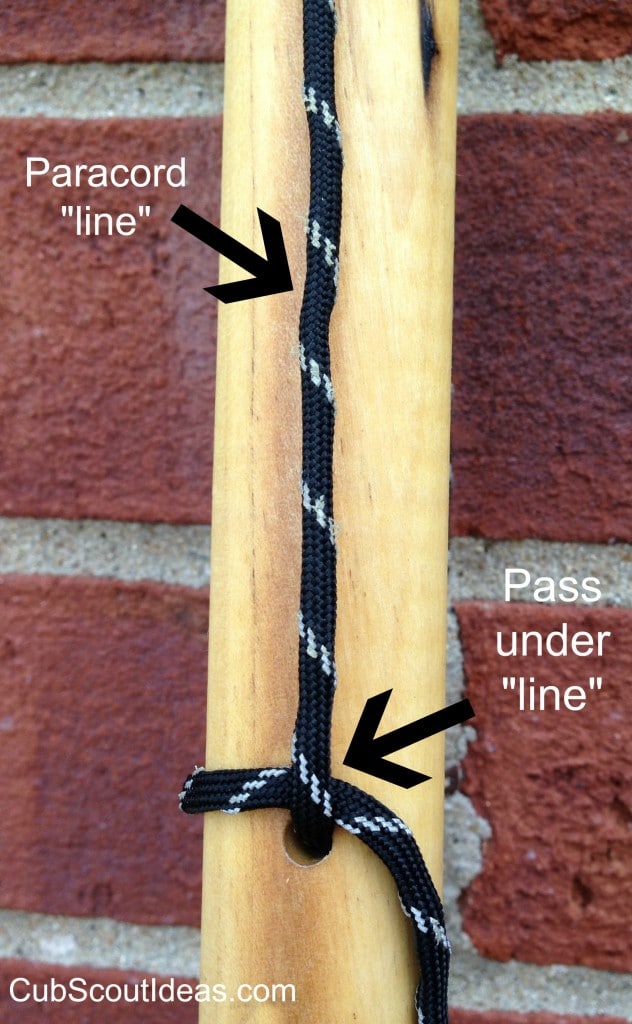
Start wrapping the handle grip up toward the top hole. On the first wrap around the dowel, pass the cord you’re wrapping between the paracord “line” and the dowel rod. This will keep the paracord from slipping.
The second wrap will go over the top of the paracord “line”. The third pass will go between the line and the dowel rod.
Continue alternating between going over the top of the “line” and going between the “line” and the rod. This will hide the string going from the bottom hole to the top.
Every couple of passes, push the cord down so that there are no gaps between the wraps. Wrap the cord as tightly and as high as possible.
When you reach the top hole, insert the cord through it going in the same direction as the other part of the wrist strap. Tie a square knot to keep tension on the wrapped part of the handle.
Step 6: Attach whistle
Trim the wrist strap to your desired length, and attach the survival whistle. Attaching the zipper pull is a very tight fit, so you’ll need to remove about an inch of the inner threads from the paracord.
And now, your hiking stick is completed! Make sure you plan a hike soon so that the Scouts can test out their new hiking sticks.
How to Easily Make a Cub Scout Hiking Stick
Your Cub Scout can make a handmade hiking stick. This fun craft project is useful and can bring back fond memories when they hike with it for years to come.
Materials
Tools
Instructions
- Prior to distributing the hiking sticks to the Scouts, pre-drill the dowel rods. Start by drilling a 20 mm hole in the top of the dowel rod. This is for the compass. Make sure the hole is deep enough for the compass to sit level with the top of the rod. Drill two holes for the handle. The first should be approximately 3″ from the top (where the compass will be), and the second should be approximately 9″ from the top.
- Step 1 – Give the Scouts their dowel rod and some sandpaper so that they can sand the rod. The Scouts are to draw designs on their rods with pencils.
They can do this freehand or use carbon paper (yes, you can still get it!) to trace the designs onto the rod. The Scouts should not draw between the two holes because anything there will be covered up by the paracord handle. - Step 2 – Parents should do this step. Using a wood burning tool, trace over the drawings.
- Step 3 – This step will need to be done at home. Give the Scouts baby food jars (or other small containers) with 2 or 3 ounces of Danish oil. They should apply 3 or 4 coats before the next meeting. Using a clean rag, apply the Danish oil generously to the hiking stick. Keep rubbing the stick until the wood seems to stop absorbing the oil.
Allow the stick to dry overnight, and apply another coat. Repeat until you’ve applied 3 or 4 coats. Make sure you’ve sealed the inside of the holes, the top and the bottom of the rod. The last coat of Danish oil should be applied at least 48 hours before your next meeting to give it time to dry completely. - Step 4 – Glue the compass into the recessed area on the top of the hiking stick. If needed, glue the rubber tip to the bottom.
- Step 5 – Wrap the paracord to form a grip and a wrist strap. You’ll start by inserting one end of the paracord through the top hole. Pull through the hole leaving about 9″ – 12″ hanging free. This will be part of the wrist strap. Insert the other end through the bottom hole, and pull tight.
Start wrapping the handle grip up toward the top hole. On the first wrap around the dowel, pass the cord you’re wrapping between the paracord “line” and the dowel rod. This will keep the paracord from slipping.
The second wrap will go over the top of the paracord “line”. The third pass will go between the line and the dowel rod. Continue alternating between going over the top of the “line” and going between the “line” and the rod. This will hide the string going from the bottom hole to the top. Every couple of passes, push the cord down so that there are no gaps between the wraps. Wrap the cord as tightly and as high as possible.
When you reach the top hole, insert the cord through it going in the same direction as the other part of the wrist strap. Tie a square knot to keep tension on the wrapped part of the handle. - Step 6 – Trim the wrist strap to your desired length, and attach the survival whistle. Attaching the zipper pull is a very tight fit, so you’ll need to remove about an inch of the inner threads from the paracord.
And now, your hiking stick is completed! Make sure you plan a hike soon so that the Scouts can test out their new hiking sticks.
Yours in Scouting,
Sherry
P.S. Check out these other wood projects for Cub Scouts!
36 responses
-
Want to do this. Do we really need 17 feet of paracord per stick? Its a bit expensive so I want to ask before I buy it
-
[…] Would your boys enjoy making their own hiking stick? Read the instructions […]
-
My webelos made these tonight. We painted ours. They turned out awesome. Thanks for sharing. Just having trouble getting end of paracord through the hole with the other end. Any suggestions?
-
This was a fun project for our Bear den. It took a few meetings and some “home time” to complete. The progression of each boys walking was great to see! The boys really enjoyed personalizing the sticks. My son left a blank side of the stick to add walking stick plaques from areas visited! Pack 747, Vista, California. Bear den 4.
-
As a former Cub Scout Wolf Leader, Bear Lear, Cubmaster and Committee Chairman, as well as a Boy Scout Committee Member for several years, I really enjoyed reading this post about making hiking sticks. My own cub Scout is now 24 YO and made Eagle Scout at 13. I hope if he has sons one day he will go through Scouting with them as his father and I did.
I have one question about your hiking sticks. Since they’re for Cub Scouts, are the top mounted compasses functional or just “decorative”? Aside from your Webelos, and maybe even counting some of them, I couldn’t help wondering how many of your Cub Scouts can actually look down on the top of a four foot hiking stick. Maybe I’ve just forgotten how tall my boys were.
-
Thanks for your service to Scouting!
They are “functional,” but I’m not sure how accurate they are. If I were hiking somewhere that I needed a compass to navigate with, I would take another one.
It really depends on the boy. Most of the guys in my Webelos den could see the top.
-
-
Am I reading correctly that it is 17 feet of para cord per stick? That seems like a lot…Thanks for clarifying, and thanks for this great idea!
-
Yes, 17 feet is correct. It does seem like a lot but because you have to wrap it around the dowel so many times, you need this much. Thanks for reading!
-
It’s a pi thing. Use it as a teaching opportunity. Pi is a little over three. If your line is 1/4 inch and you want an eight inch grip. 8×4 is 32 wraps. If your stick is 1 inch you need a little more than 3” for each wrap. So rounding up that is more than 96” plus extra for the knots and loops. You would rather have two feet leftover than be two inches short.
-
-
-
Our Bears made these hiking sticks this year. They had a great time and the sticks look great.
Pack 444 in Michigan.-
So glad they enjoyed the project!
-
1
-
-
[…] Would your boys enjoy making their own hiking stick? Read the instructions […]
-
Do you have more pics. I’m a woman I need more pics of how these are made. I really, really like the hiking sticks. In fact want to make one for myself while the bear cubs are working on theirs.
Thank you for putting everything where we can order supplies for project. I really appreciate it.Sincerely,
Geri
-
I’m so sorry, but I don’t. Because we made these as a den, I didn’t think to take any pictures during the process. If you have any questions while you’re working on them, don’t hesitate to email me at [email protected]. I’ll be glad to help in any way!
-
1
-
1
-
1
-
Leave a Reply